
Maine Coon Health Testing : HCM, Hip & DNA | Sassy Koonz
At Sassy Koonz, health testing is not just something we do — it is one of the foundations of our entire breeding program. When it comes to breeding Maine Coons, we have a very clear philosophy and a very clear order of priorities:
Health first. Temperament second. Type third. That order is intentional, and it never changes.
Of course we want our cats to be beautiful. Of course we care deeply about temperament. But no matter how stunning a cat may be, or how sweet and social they are, we will always choose health first. That is the standard we hold ourselves to here.
Now, I also want to be very honest about something from the beginning: there is no such thing as a perfect cat. There is no breeder anywhere who can guarantee that every kitten they produce will live a completely issue-free life. That is simply not reality when you are working with living animals and genetics.
What is realistic — and what I believe responsible breeders should be doing — is taking every precaution possible, testing thoroughly, tracking outcomes long-term, and making hard decisions when the data tells you it’s necessary.
That is exactly what we do at Sassy Koonz Maine Coon Cattery.
Why Health Testing Matters in Maine Coons
As a pedigree cat breeder, I believe health testing is one of the most important responsibilities we have.
Pedigree cats, including Maine Coons, have been selectively bred over generations to preserve certain traits — things like size, coat, temperament, and overall breed type. But selective breeding can also preserve health risks if breeders are not being careful and intentional. That is why health testing matters so much.
Genetics play a very real role in the outcome of the kittens we produce. And while we cannot control every possible variable in a cat’s future, we can do everything in our power to reduce preventable risk on the front end.
Health testing does not eliminate risk completely. Nothing does. But it does help us make smarter breeding decisions, avoid known issues when possible, and move forward with much more confidence that we are doing the right thing for our cats and for the families who trust us.
At the end of the day, I want to know that we have done everything we reasonably can to produce healthy kittens to the best of our knowledge and ability.
What We Test Our Breeding Cats For
At Sassy Koonz, we have a very specific health testing protocol that all of our breeding cats go through. Some of this is routine and foundational. Some of it is more advanced.
Our breeding cats are evaluated through:
- Annual health exams
- Routine parasite screening
- PCR testing when indicated
- Hip X-rays with OFA evaluation
- Echocardiograms for HCM screening
- Comprehensive DNA testing
Each of these tests tells us something different, and together they help us build a much more complete picture of a cat’s health.
Parasite and infection screening
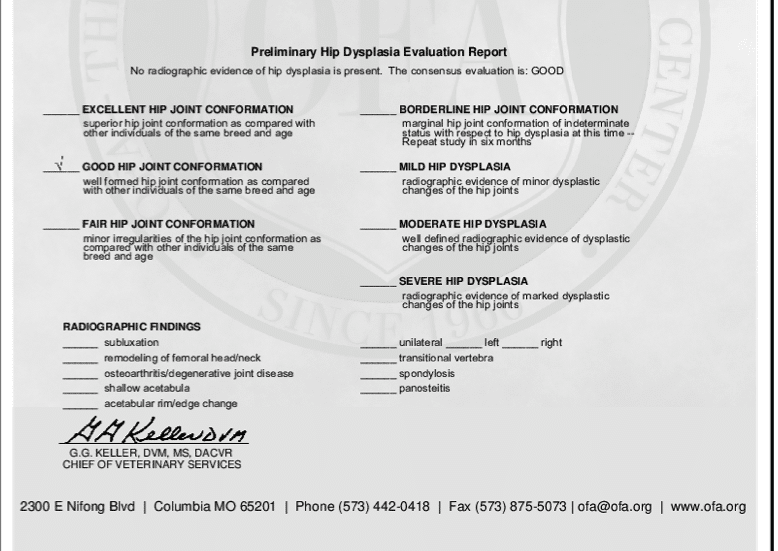
As part of our annual health care, our cats receive routine parasite checks. We also use more advanced PCR testing when we need a deeper look into possible infections, reproductive concerns, parasites, bacteria, or viruses.
This is important because some of these pathogens can absolutely affect breeding health and, in some cases, be passed to kittens if not properly identified and addressed.
Hip evaluations
Because Maine Coons are a large and heavy-boned breed, hip health matters a lot. They’re prone to developing hip dysplasia.
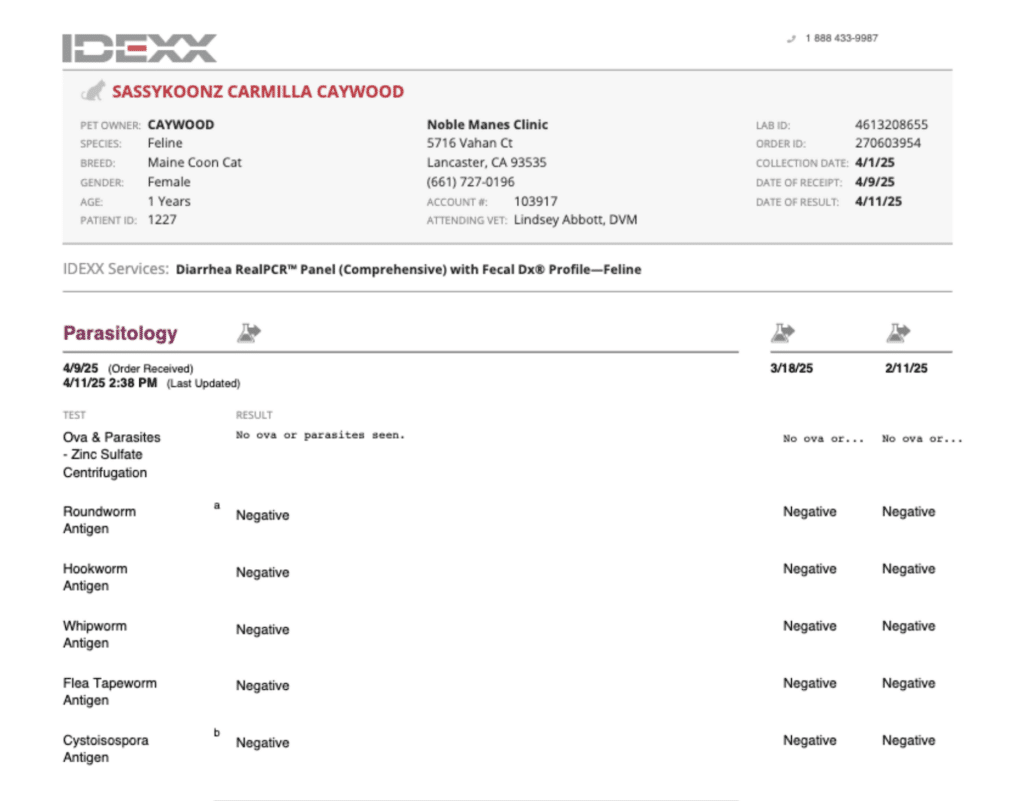
That is why we do hip X-rays and have them reviewed through OFA (Orthopedic Foundation for Animals). Hip ratings help us understand which cats are stronger structural candidates for breeding and which pairings require more caution.
Below is a partial shot of an evaluation report from OFA on one of our breeding Queens. We have to be careful about the documentation that we post on our website, due to scammers who steal it and use it with ill intent. But we do want to share examples for educational purposes.
HCM screening
One of the most important screenings we do is for hypertrophic cardiomyopathy (HCM), which is one of the most well-known health concerns in Maine Coons. We screen for this through echocardiograms, which are ultrasounds of the heart.
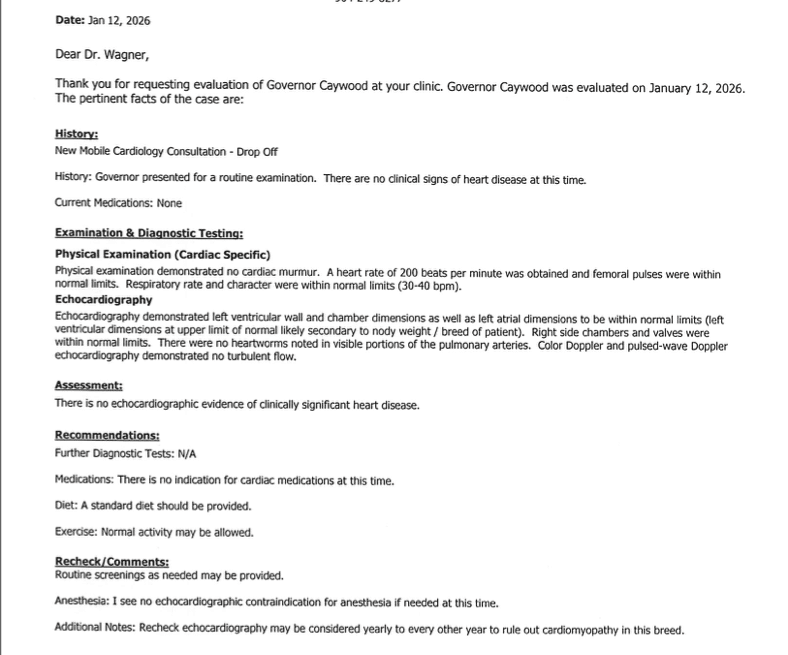
Below is an example of the echocardiogram results for our Sire, Governor. Some people may wonder why we keep Gov in our program for as many years as we have (he is 4 years old). The answer is simple! Governor has an excellent health record and so do his kittens! We’ve been tracking his offspring since Day 1, and we are very pleased with the results.
DNA testing
We also perform DNA testing, which screens for nearly 50 genetic risks, along with certain traits and inherited characteristics that may not be obvious otherwise. DNA testing is a very useful tool — but I also think it is one of the most misunderstood tools in breeding.
DNA Testing vs. Real-World Health Screening: What Buyers Needs to Know
This is something I wish more kitten buyers knew. A lot of breeders will say they “DNA test,” and that is often where the conversation stops. While DNA testing is absolutely important and necessary, it is only one layer of responsible health screening. It does not tell the whole story.
DNA testing tells us what a cat is genetically carrying. It does not tell us everything that may happen in that cat’s actual life.
For example:
- A cat may test clear for an HCM gene on the DNA test and still develop HCM later in life. Conversely, a cat may also be a carrier of the HMC gene, and never develop the disease.
- DNA testing does not screen for hip dysplasia, only a proper hip x-ray does.
- It also does not evaluate many of the real-world health issues we actually see in cats over time.
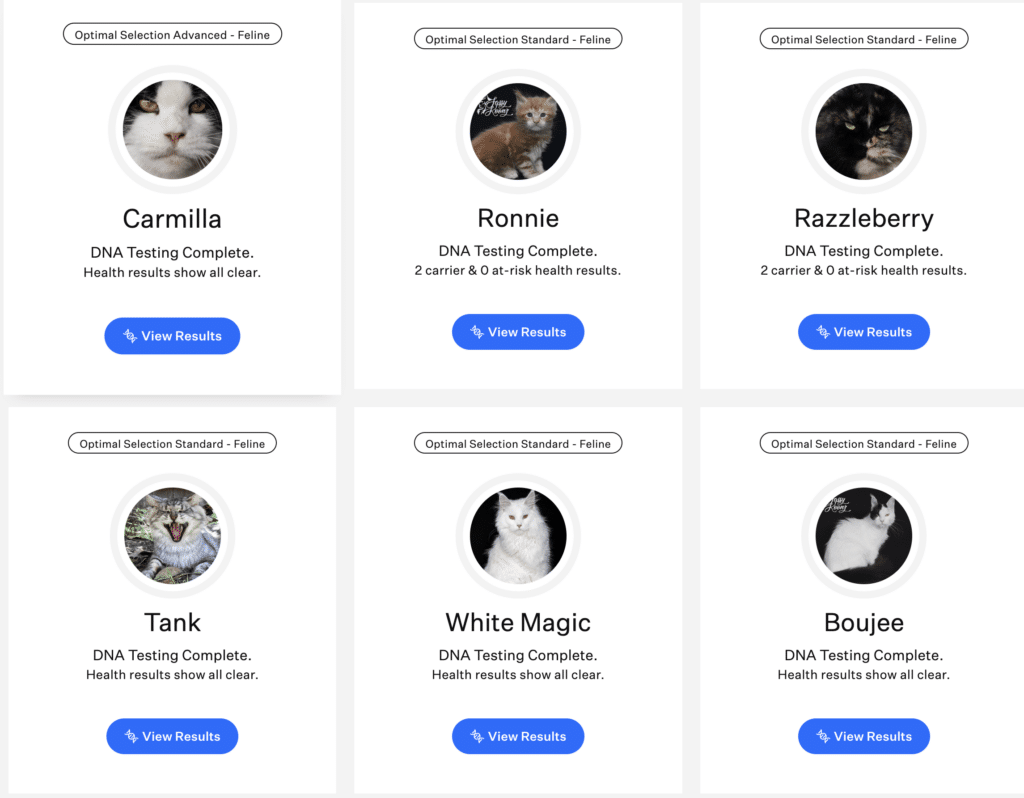
Below is a screenshot of our Wisdom Health account, with several of our breeding cats (Active and Retired) DNA testing results. Upon clicking into each record, we can see all of the results from the DNA testing.
Why real-world screening matters
This is where real-world health screening becomes so important.
A PCR test, for example, may involve a:
- blood sample
- vaginal swab
- fecal sample
That test can help identify infections, parasites, bacteria, or viruses that would never show up on a DNA panel. And those things matter — especially in a breeding program.
So when I talk about health testing, I am not just talking about checking a genetic box. I am talking about looking at the cat as a whole and asking:
What is this cat carrying genetically?
What is this cat showing physically?
And what could this cat realistically pass on?
How We Use Test Results To Make Breeding Decisions
Health testing only matters if you are actually willing to make decisions based on the results. And sometimes those decisions are not easy. At Sassy Koonz, there are times when test results force us to slow down, reassess a pairing, or even remove a cat from the breeding program entirely. That is part of doing this responsibly.
Example: Hip ratings
Let’s say a cat receives a fair hip rating through OFA. That does not automatically mean the cat can never be bred — but it does mean we have to be extremely intentional about what that cat is paired with. A cat with fair hips would only ever be paired with a cat that has excellent hips.
Why? Because if you start pairing lower-rated cats together, the risk of producing kittens with more significant structural issues goes up. That is exactly the kind of decision health testing helps us make.
Example: Recessive disease carriers
Another example would be a cat that carries a recessive condition such as PK deficiency. If a cat has only one copy of that gene, it may never be affected itself. But if you pair it to another carrier, you increase the risk of producing kittens who inherit both copies and are therefore at much higher risk.
So if a cat is a carrier, we simply do not pair it with another carrier. Again, this is where DNA testing becomes useful — not as a standalone “health guarantee,” but as a tool for making informed decisions.
Example: Blood type compatibility
We also use DNA testing to check blood type, because there is a serious issue that can occur called neonatal isoerythrolysis (NI).
This happens when:
- the mother is blood type B
- and the kittens are blood type A
In that situation, the antibodies in the mother’s early milk can attack the kittens’ red blood cells, which can be fatal. If you know about that risk in advance, you can either avoid the pairing altogether or manage it very carefully after birth.
We have never had a blood type B mother in our program, but this is exactly why testing matters — because if a risk exists, I want to know about it before it becomes a tragedy. Personally, I prefer to avoid that situation entirely if possible. I want our mothers to be able to nurse and care for their kittens naturally, especially during those fragile first days of life.

How We Prioritize Long-Term health, Not Just Pretty Kittens
This is one of the biggest differences in how I think about breeding. Yes, I love beautiful Maine Coons. I appreciate a gorgeous cat just as much as anyone else. But producing pretty kittens is not the only mission here. It’s definitely not the most important.
The mission is to produce kittens that have the best possible chance at a healthy, happy, long life. That means I cannot only focus on what a kitten looks like at 10 or 12 weeks old. I have to think years down the road.
Our annual health surveys
One of the ways we do that is through our annual kitten health surveys. Every year, on each cat’s birthday, we send the owner a short email asking them to take about five minutes and update us on their cat’s health. That information is incredibly valuable.
It helps us look at:
- how kittens are doing over time
- whether patterns are emerging
- whether certain lines appear especially strong
- and whether anything concerning may be developing genetically
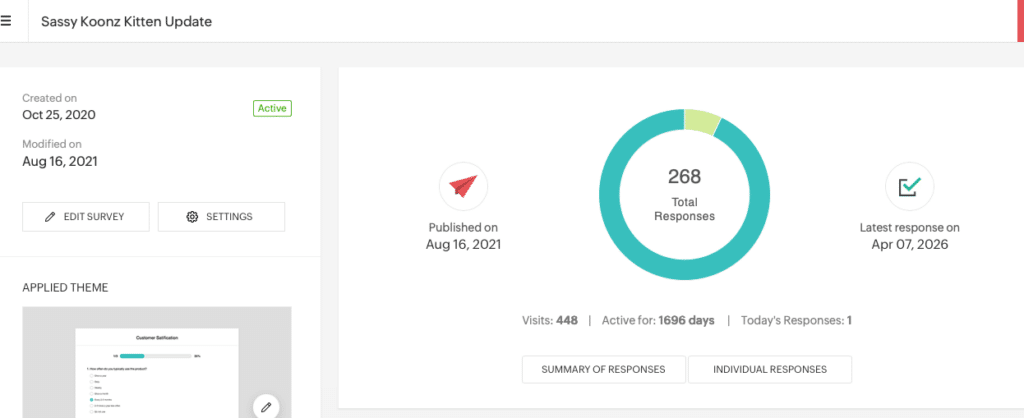
This is one of the most important tools we have for tracking the true long-term health of our program. Because once a kitten leaves our home, the only way we can keep learning from that cat’s outcome is if the family stays in touch and shares that information with us.
We have been collecting this data for about six years now, and around 40% of our families participate consistently. To those families — I truly mean this — we are so grateful.
That information helps us make better decisions for future kittens, future families, and the long-term health of our lines.
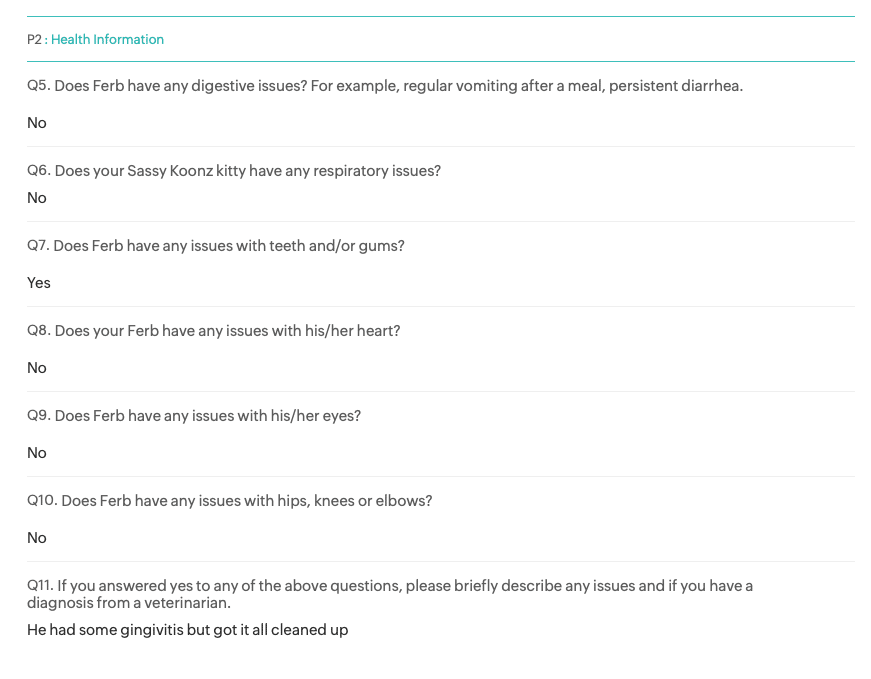
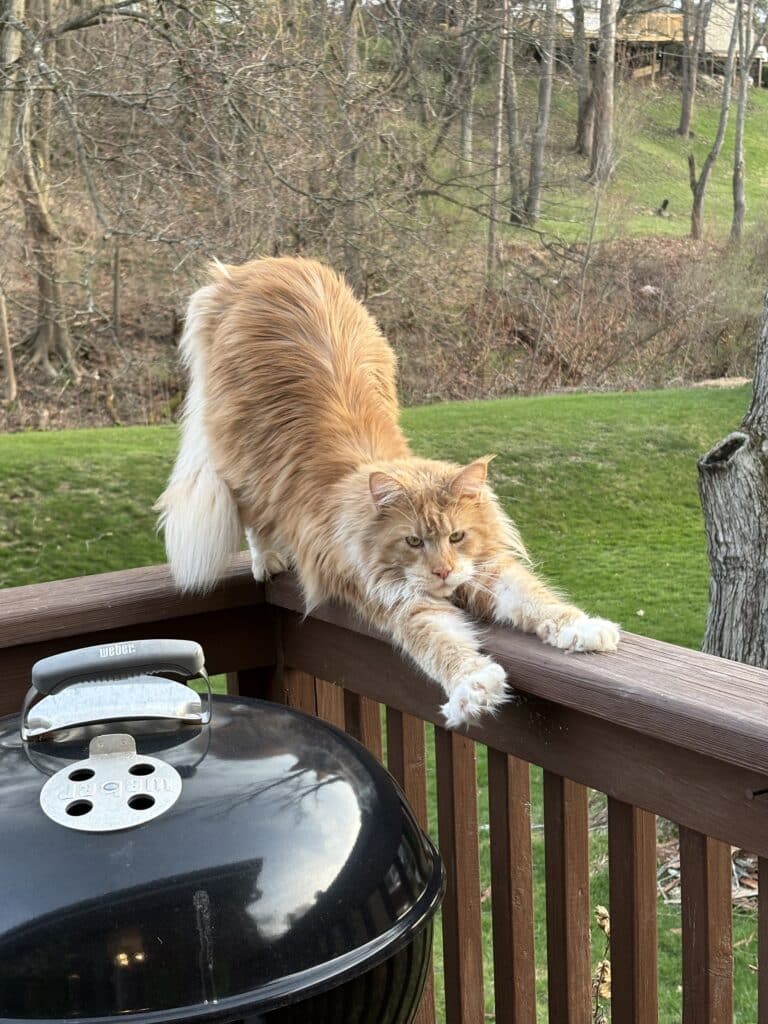
Shown below is a screenshot of just the first section of our annual health survey. This one was received recently, regarding one of our kittens named Kiszka (now called Ferb). He is 2 years old as of the date of the survey, and it seems he is doing well aside from a little gingivitis! I also received a photo update of him, which we ask for in addition to the survey.
How We Track Health Patterns in Our Cattery
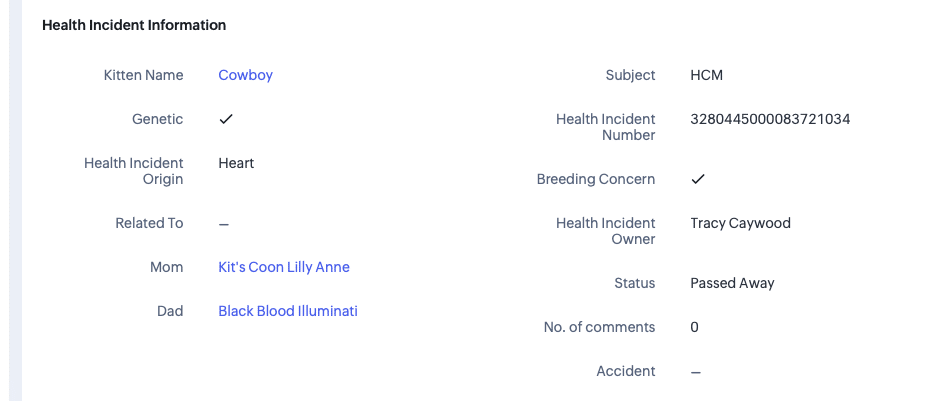
In addition to our surveys, we also maintain an internal system to track reported health issues in our kittens and breeding cats. Whenever a meaningful health issue is reported to us from the owner, we document it.
That includes:
- the date
- the diagnosis
- the treatment
- the outcome
- and the parents involved
We then link those outcomes back to the mother and father so we can identify whether there is a pattern beginning to form. That kind of tracking is invaluable. Because a single issue may be random. But repeated issues from the same line deserve attention.
Below is a screenshot of an HCM record that we have documented. This particular kitten (named Cowboy) passed away at the age of 5 years old.
Our internal philosophy
Over the years, I’ve developed a simple philosophy around this:
- One health issue may be an anomaly
- A second issue becomes a red flag
- A pattern requires action
A real example
We once had a queen whose kittens developed FIP in multiple separate cases over a relatively short period of time. The first case felt like it could have been an unfortunate anomaly. Then the second case happened. That got my attention immediately.By the time a third case surfaced, there was no question in my mind — that Queen needed to be retired and spayed. And she was.
That was one of the first major moments that really solidified how important our tracking system is. Because by the time a health issue is reported to a breeder, that cat may have already had multiple additional kittens placed in homes. That means time matters.
If I see a pattern, I am not going to sit around and hope it was coincidence. I would rather make the hard decision early than continue a line that may be putting future kittens at unnecessary risk. That is what protecting the integrity of a breeding program looks like to me.
The Two Questions Buyers Should Ask Any Maine Coon Breeder About Health Testing
I think a lot of kitten buyers simply do not realize how important health testing really is. Most people naturally fall in love with photos and videos first. That makes sense. Buying a kitten is emotional, and it should be. But before you make that decision, you need to go deeper than what the kitten looks like.
If you are considering a Maine Coon breeder, these are the questions I would encourage you to ask:
How do you prioritize long-term health in your breeding program?
The answer to this question will usually tell you whether that breeder is truly thinking long-term… or just producing kittens.
What are your health incident numbers?
This is a very important question — and one I wish more buyers would ask.
Ask things like:
- How many cases of HCM have you had?
- How many cases of hip dysplasia?
- Have you had any FIP cases?
And I want to say something very directly here: If a breeder tells you they have had zero cases of everything over many years of breeding, that is a red flag to me. They could potentially be telling a fib.
Not because good breeders “cause” these issues — but because if you breed long enough, with enough cats, you are going to see difficult things eventually. That is just the reality of working with pedigree cats.
So the better question is not: “Have you ever had a problem?”. The better question is: “What did you do when the problem happened?”
- Did they track it?
- Did they acknowledge it?
- Did they make a change?
- Did they retire the cat if necessary?
Why Transparency Matters to Us
Unfortunately, not every Maine Coon breeder is transparent. That matters — especially now, when most buyers are discovering breeders online and making decisions based on websites, photos, videos, and social media.
Trust matters more than ever. And in my opinion, trust is built through our transparency pledge.
At Sassy Koonz, I want people to understand exactly how we operate, what we test, what we track, what we care about, and where our priorities are. I do not want anyone buying from us under the illusion that we think our kittens are “perfect.” We do not think that. We know that despite doing everything right, some kittens may still go on to develop health issues later in life.
And if that happens, I want to know about it. I want to help if I can. I want to support the family. And I want to use that information to improve future decisions inside our cattery. That is how we will get better over time.
Our health reporting philosophy
We maintain a page on our website where we report significant health issues that have occurred in our lines. We do not list every small or routine issue — things like mild sneezing, occasional diarrhea, or other common cat concerns are not uncommon and do not tell the full story.
But I believe buyers deserve to know the numbers. when it comes to major concerns like:
- HCM
- Hip dysplasia
- FIP
Not because it is fun to talk about. Not because it is flattering. But because it is honest. And I would rather be honest than polished. If someone is going to trust us with such an important decision, then I believe they deserve access to real information so they can decide what level of relative risk they are comfortable with.
Frequently Asked Questions about Maine Coon health testing protocols
How long does it take to get DNA results back on a Maine Coon?
Once you submit the DNA swabs, which are collected from the inside of the cat’s mouth, it typically takes 2-3 weeks to receive the results. The results can be viewed online.
How often should you screen a Maine Coon for HCM?
The first cardiac ultrasound should be performed by a board-certified cardiologist around the age of 1 to establish a baseline. Breeding cats should be screened yearly. Pets can be screened biannually.
What is the most common discovery in a fecal PCR test for a Maine Coon?
The most common pathogen found in a fecal PCR test for a Maine Coon is coronavirus. This is found in 90% of all cats, especially in multi cat and breeding environments.
How long are Maine Coon DNA test results good for?
DNA test results need only to be done once since our DNA never changes from birth.